The Complete Month-by-Month Guide to the Great Migration
The Complete Month-by-Month Guide to the Great Migration
Understanding the Living Cycle of the Great Migration
The Great Migration is not a single event that begins and ends, but rather a continuous ecological cycle shaped by rainfall, grazing pressure, and instinctive movement patterns that have evolved over thousands of years. It is one of the few remaining large-scale wildlife systems on Earth that still functions without human scheduling, meaning its timing shifts subtly each year depending on when and where rain falls across the Serengeti ecosystem and surrounding plains. At its core, the migration is driven by survival rather than destination. Wildebeest, zebras, and gazelles move in response to fresh grass growth, which itself follows the movement of seasonal rains. This creates a circular pattern of movement that stretches across vast landscapes, connecting southern plains, central woodlands, northern river systems, and back again.
What makes this phenomenon especially complex is that it is not a synchronized march of animals but a constantly shifting distribution of herds that expand, contract, split, and reunite depending on local conditions. At any given time, there are multiple fronts of movement happening simultaneously, with some groups feeding, others calving, and others already moving toward new grazing areas. Predators follow closely behind, creating one of the most dynamic food webs on the planet. Lions, cheetahs, hyenas, and crocodiles are all integrated into this system, responding to the movement of prey rather than acting independently. The result is a living cycle of tension, abundance, risk, and renewal that defines East Africa’s savannah ecosystems.
Understanding the migration month by month is not just about tracking animals across a map. It is about understanding how life responds to environmental change on a continental scale. Each phase of the year reveals a different expression of survival strategy, from birth and vulnerability to endurance and return.
January to March: The Southern Plains and the Calving Intensity
From January through March, the Great Migration is concentrated in the southern Serengeti and the Ndutu plains, where volcanic soils create nutrient-rich grasslands that support intense grazing and high reproductive success. This is the calving season, one of the most biologically significant events in the entire cycle. During this relatively short window, hundreds of thousands of wildebeest calves are born in a synchronized period that spans only a few weeks. This timing is not accidental but an evolutionary adaptation designed to overwhelm predators with sheer numbers, increasing the survival rate of individual calves.
The landscape during this time is open, flat, and highly visible, which plays a crucial role in both survival and predation. Mothers give birth in close proximity to one another, forming temporary clusters of protection where newborns can stand and move within minutes of birth. The speed of development is essential because vulnerability is extremely high in the first days of life. Predators such as lions and hyenas are heavily concentrated in the same region, taking advantage of the abundance of prey. However, even with intense predation pressure, the population of newborns is so large that the ecosystem maintains balance.
What makes this period especially striking is the constant contrast between fragility and abundance. Every moment contains both creation and loss, often occurring within sight of one another. Calves test their legs in the grass while nearby predators observe, calculating opportunity. The grasslands themselves are lush and green due to seasonal rains, providing both nourishment and cover. This abundance of food supports not only herbivores but also the predators that depend on them, creating one of the most productive ecosystems on Earth.
For observers, this period represents the emotional core of the migration. It is not defined by movement across distances but by the intensity of life concentrated in one region. The plains feel alive with constant motion, sound, and interaction, making it one of the most biologically active periods in the entire cycle.
April to May: Transition, Dispersal, and the Beginning of Movement
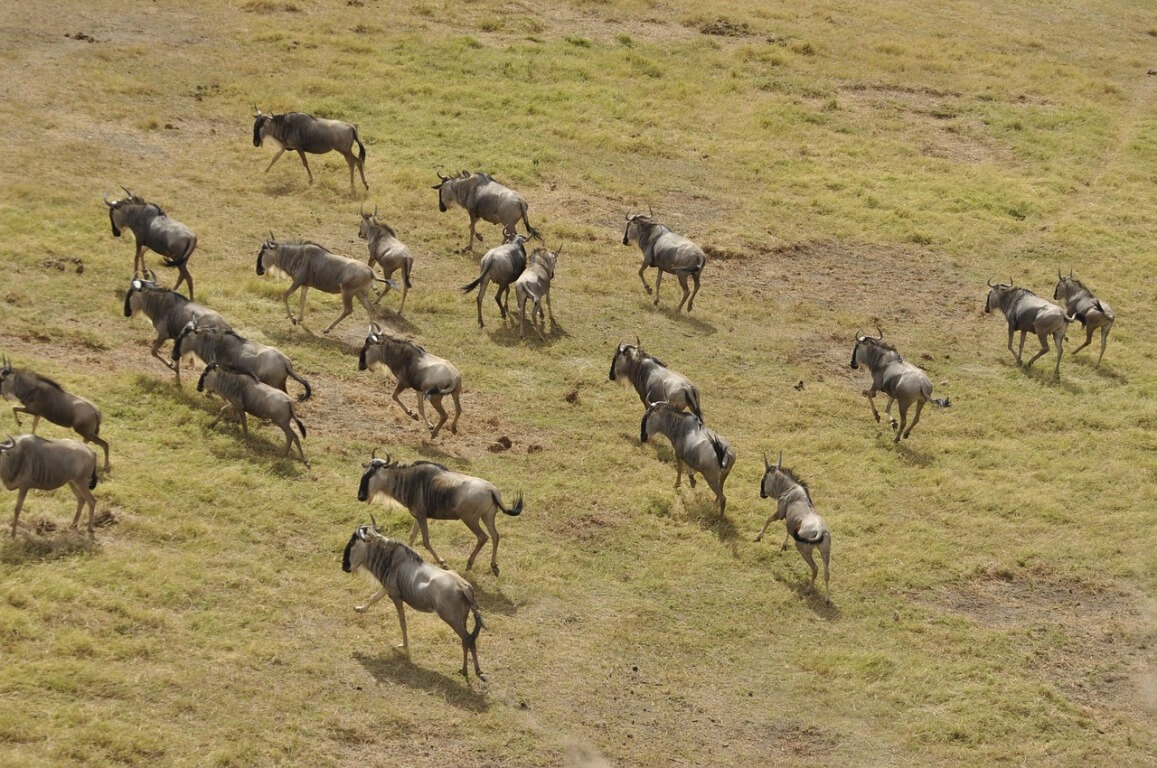
As the southern plains begin to dry and rainfall shifts northward, the migration enters a transitional phase during April and May. This is not a dramatic shift but a gradual redistribution of herds across the landscape. The tightly packed calving grounds begin to loosen as groups of wildebeest and zebras start to move outward in search of fresher grazing areas. The movement is less concentrated and more diffuse, forming broad corridors rather than dense aggregations.
During this phase, the migration becomes highly sensitive to local rainfall patterns. Even small storms can redirect movement, as herds instinctively follow patches of new grass. The animals are constantly balancing nutritional needs with safety, as moving too quickly or too far from established herd structures can increase vulnerability. This creates a dynamic where movement is continuous but not uniform, with some groups advancing northward while others remain behind feeding.
Predator activity becomes more dispersed during this stage. Instead of large concentrations of lions and hyenas in one region, predators spread out and follow smaller herd clusters. This reduces the intensity of individual encounters but increases the unpredictability of predator-prey interactions. Hunting becomes more opportunistic rather than structured around high-density prey zones.
The landscape during April and May shifts from lush green plains to a more mixed savannah environment. Grass remains available, but it is no longer uniformly abundant, forcing herds to adapt to patchier resources. Water sources become increasingly important as dry spells begin to appear. Rivers, seasonal pans, and temporary wetlands act as natural anchors that influence direction and speed of movement.
This phase of the migration is often overlooked because it lacks the dramatic intensity of calving or river crossings. However, it is essential to the continuity of the cycle. It represents endurance, adaptation, and the slow coordination of millions of animals responding to subtle environmental signals.
June to July: The Mara River Crossings and Peak Survival Pressure
By June and July, the migration reaches one of its most critical and dramatic phases as herds approach northern river systems, particularly the Mara River region. This stage is defined by high-risk river crossings that have become symbolic of the Great Migration itself. The animals gather along riverbanks in dense, restless groups, often waiting for hours or days before committing to cross. The hesitation is not indecision but an instinctive response to danger, as crocodiles lie in wait beneath the surface and currents can be unpredictable and strong.
When crossings begin, they are sudden and chaotic rather than organized. Pressure from behind forces the first animals into the water, triggering a cascading movement where thousands follow within minutes. The river becomes a site of extreme survival pressure, where speed, timing, and chance determine outcomes. Crocodiles exploit this moment of vulnerability, targeting animals that are separated, weakened, or swept away by currents. Despite this, the majority of the herd typically succeeds in crossing, driven by the necessity of reaching fresh grazing on the opposite bank.
Once across the river, the herds regroup and continue moving into northern grasslands. However, the psychological and physical toll of the crossing remains evident. Calves that survive this stage are significantly more resilient, having already endured one of the most dangerous phases of the entire migration cycle. The river crossing acts as a natural filter, reinforcing survival traits across generations.
For observers, this period represents the most intense and unpredictable aspect of the migration. It is not a guaranteed spectacle, as crossings depend entirely on natural conditions and herd behavior. When they do occur, they reveal the raw mechanics of survival at its most concentrated form.
August to September: Northern Grasslands and Sustained Pressure
During August and September, the migration spreads across northern grasslands where grazing remains relatively stable but competition and predator presence remain high. The herds are now more dispersed than during earlier phases, but still maintain enough density to support predator populations. Lions, leopards, and hyenas actively track herd movement, while cheetahs exploit open terrain for high-speed hunting opportunities.
This phase of the migration is characterized by balance rather than extremes. Food is available but not limitless, forcing continuous movement within the region. Water sources play a central role in determining herd distribution, as animals gather around reliable supply points. These gathering areas become focal points for both feeding and predation, creating localized zones of heightened activity.
Unlike the calving season or river crossings, this stage is less visually dramatic but ecologically stable. It represents a period of maintenance within the cycle, where energy is conserved, young animals grow stronger, and herd structures stabilize after earlier disruptions. The constant presence of predators ensures that vigilance remains high, even in relatively favorable conditions.
For those observing the migration, this period offers a more balanced view of ecosystem interaction. It reveals how large-scale movement translates into daily survival patterns across different species sharing the same environment.
October to November: The Return Movement South
As rainfall begins to shift southward again, the migration enters its return phase during October and November. The northern grasslands begin to dry, reducing grazing quality and prompting herds to gradually move back toward southern regions. This movement is less urgent than earlier phases but still continuous, driven by the need to follow fresh vegetation.
The return journey is shaped by memory and environmental cues rather than fixed pathways. Herds often retrace parts of their earlier routes, but not always in identical patterns. The landscape itself guides movement, with fresh rainfall creating temporary grazing zones that attract herds in shifting directions.
Predator activity remains present but becomes more diffuse as animals spread out during movement. Younger members of the herd, now more developed after months of growth, are better able to endure long distances and fluctuating conditions. This increases overall herd resilience as the cycle progresses toward completion.
This phase reflects the adaptive intelligence of the migration system. It is not a reverse journey but a redistribution of life across changing environmental conditions.
December: Completion of the Cycle in the Southern Plains
By December, the herds return to the southern plains where fresh rains have regenerated grasslands. This marks the completion of the annual cycle, though in ecological terms it is simply the continuation of a repeating process. The southern plains once again become the center of grazing activity, preparing the system for another calving season.
The landscape during this period is renewed, with soft green grass supporting large concentrations of herbivores. Energy is restored after months of movement, and herd structures stabilize in preparation for reproduction. Predator populations adjust accordingly, concentrating where prey density is highest.
There is a sense of temporary balance during this phase, although it is never permanent. The ecosystem remains in motion even when it appears calm, as rainfall patterns begin to set the stage for the next cycle of movement.
The Great Migration, viewed across the full year, is not a journey with a destination but a continuous expression of ecological rhythm. It reflects the deep connection between climate, landscape, and survival in one of the most dynamic wildlife systems on Earth.
